One Week After AdMob: Migrating 100+ Android Apps to Unity LevelPlay + Unity Ads
One week after Google rejected our publisher appeal, we migrated our Android wrapper to Unity LevelPlay mediation and Unity Ads. From 2 pilot apps to 7 new launches and 20 existing apps, here is our checklist covering SDK isolation, R8 verification, app-ads.txt, and Play Data Safety.
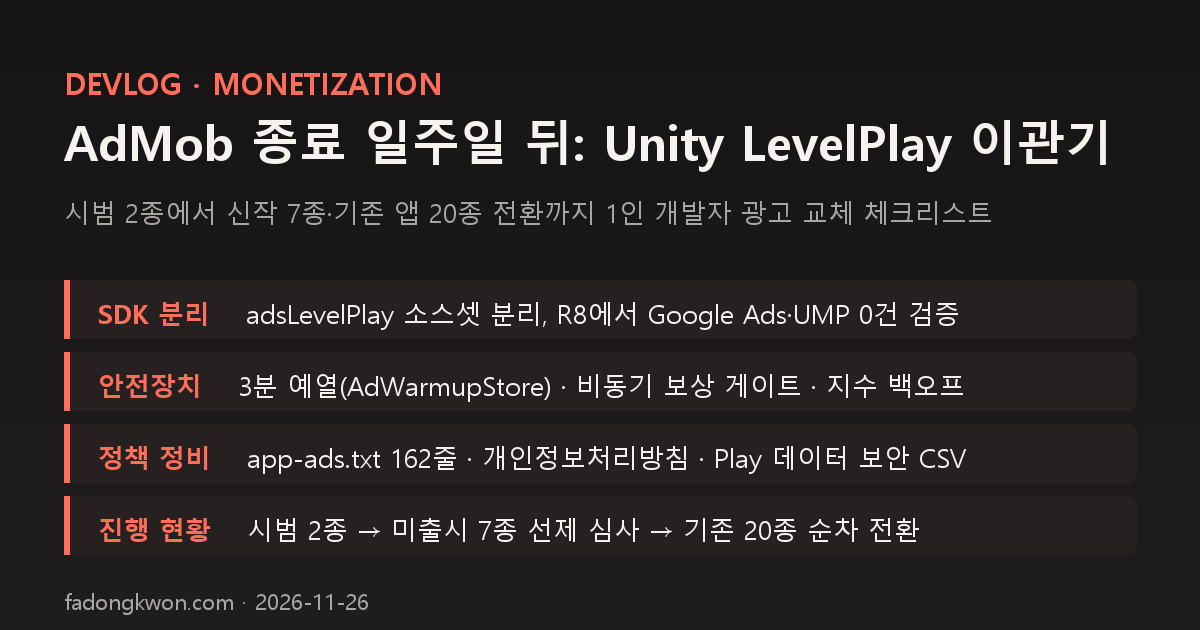
한국어로 읽기 AdMob 종료 일주일 뒤: Unity LevelPlay + Unity Ads로 갈아탄 실전 이관기
On November 19, Google rejected our publisher account appeal, halting ad monetization across more than 100 Android apps on Google Play overnight. The path forward was clear: leave Google’s publisher ecosystem behind and migrate to a new ad network.
Over the past week, we adopted Unity LevelPlay mediation + Unity Ads, starting with two pilot apps (breakout and gonu), followed by seven unreleased apps submitted directly with LevelPlay, and two rollout batches covering 20 existing live apps. Here is how we structured the migration to avoid breaking a 120-flavor monorepo.
1. One Properties File as the Network Switch
Our Android wrapper (apps-in-toss-games/android/app) builds over 120 product flavors. Branching by app name in Kotlin would quickly become unmaintainable, so we made the presence of a single config file the switch:
- If
android/levelplay-<id>.propertiesexists, Gradle automatically wires that flavor to theadsLevelPlaysource set. levelplay-*.propertiesis gitignored so keys never touch the repository.- Both
AdManager.ktandConsentManager.ktpreserve the exact same public contract asadsReal.MainActivity.kt,MiniBridge.kt, and all 100+ web games stay completely unaware of which ad SDK sits underneath.
Apps in Toss builds use Toss IAA, so none of those bundles were touched.
2. Stripping Google Mobile Ads & UMP, Verified via R8
Leaving Google Mobile Ads or com.google.android.gms.ads.APPLICATION_ID behind in manifests only adds bloat and confusion.
- We moved the UMP
ConsentManager.ktintosrc/adsUmp/so only legacy flavors pull it in. src/adsLevelPlay/AndroidManifest.xmlomitsAPPLICATION_IDentirely and declares onlycom.google.android.gms.permission.AD_ID.- Dependencies are scoped to
mediation-sdk:9.8.0andunityads-adapter:5.17.0(bundling Unity Ads SDK 4.22.0).
Instead of assuming the separation worked, we counted classes directly in R8’s mapping.txt after release builds:
| Release Flavor | Google Mobile Ads (excl. identifier) | UMP | LevelPlay | Unity Ads | Manifest APPLICATION_ID |
|---|---|---|---|---|---|
breakoutRelease (pilot) | 0 | 0 | 27 | 870 | None |
gonuRelease (pilot) | 0 | 0 | 27 | 873 | None |
reactionRelease (legacy control) | 376 | 6 | 0 | 0 | Present |
mathMonstersRelease (kids adsStub) | 0 | 0 | 0 | 0 | None |
Kids apps (adsStub) continue to ship with zero ad SDK classes.
3. Seven Safeguards Built Into the New Wrapper
Switching ad networks does not make invalid traffic disappear—new accounts start with low trust and need tighter guardrails from day one:
- Untrusted environment gate (
AdSafety): Debuggable builds, emulators, rooted devices, and installs outsidecom.android.vendingskipLevelPlay.init()completely (zero ad requests). - Ad warm-up window (
AdWarmupStore): After a fresh install,LevelPlay.init()waits until the user accumulates 3 minutes (180,000ms) of foreground time and either launches a second session or completes one round. Until then, the banner container stays collapsed (GONE). - Async reward gate (
RewardedOutcomeGate): Even ifonAdRewardedandonAdClosedarrive out of order, a 600ms grace window after close ensures the web layer receives exactly one"earned"or"dismissed"callback. - Auto-refresh pause & exponential backoff: Daily cap blocks (20/day), in-gameplay banner hiding, and host pause call
pauseAutoRefresh(). Load failures back off exponentially up to 64 seconds. - Privacy flags before init: GDPR, CCPA, and COPPA metadata flags are applied immediately before
LevelPlay.init(). - Local ad telemetry (
AdLocalStats): Daily counts per format (banner, interstitial, rewarded) are stored locally for 30 days for quick sanity checks. - Release gate (
checkAdIds): Fails release builds if keys or unit IDs are blank, malformed, or accidentally contain Google test IDs or AdMob IDs.
4. Device Verification Catch
On a Galaxy S23 Ultra over wireless ADB, IntegrationHelper reported IronSource 9.8.0 VERIFIED and UnityAds 4.22.0 / Adapter 5.17.0 VERIFIED. Testing on real hardware also caught an edge case where returning from a Play Games Services sign-in dialog skipped banner attachment—we fixed that immediately in onHostResume(). As soon as a live ad rendered on the test banner, we verified gameplay hiding without clicking it and uninstalled the debug build to avoid polluting live impressions.
5. Non-Code Checklist: Policy & Store Forms
app-ads.txt: Added 162 Authorized Sellers lines from Unity Cloud Monetization plusownerdomain=fadongkwon.comto the site root.- Privacy policy: Added Unity’s privacy policy link to
https://fadongkwon.com/privacy/. - Play Data Safety CSV: Updated existing location, app interaction, and device ID disclosures with analytics and fraud-prevention purposes, and added Other actions and Diagnostics.
6. Rollout Order
After shipping the two pilots (breakout v1.2.2, gonu v1.0.4), we prioritized 7 unreleased apps so they went through first-time Play review with LevelPlay already baked in (6 of the 7 were approved on November 24). From there, we started migrating existing live apps in batches of 10—20 apps converted so far, with the rest following the same properties-file switch.